Back to Yoga

Adiyogi and the Saptarishis: How Yoga Reached Humanity

A flagship long-form article exploring the structured transmission of yoga by Adiyogi Shiva to the seven sages, featuring comparative tables on scriptural lists, yogic dimensions, and astronomical mappings.

Adiyogi Shiva, the first yogi, transmitting wisdom in the Himalayas.
Fixed formatEnglish / हिंदीTable of contentsVerse + meaning

Editorial

If Adiyogi Shiva transmitted the science of yoga in the high Himalayas, how did this profound knowledge cross geographical and temporal boundaries to reach all of humanity?

Sage of Action:

Yoga is not a property of any culture or creed; it is a technology for the human system, transmitted by the first yogi to ensure that every human has the tools for self-liberation.


Ancient verse

Bhagavad Gita 2.48

योगस्थः कुरु कर्माणि सङ्गं त्यक्त्वा धनञ्जय। सिद्ध्यसिद्ध्योः समो भूत्वा समत्वं योग उच्यते॥

yogasthaḥ kuru karmāṇi saṅgaṁ tyaktvā dhanañjaya | siddhyasiddhyoḥ samo bhūtvā samatvaṁ yoga ucyate ||

Meaning in English

Perform your actions, O Dhananjaya (Arjuna), being established in Yoga, abandoning attachment, and remaining even-minded in both success and failure. This evenness of mind is called Yoga.

This verse defines "Samatvam" (evenness of mind/equanimity) as the core state of Yoga.

Section

Introduction: The Primeval Question

Adiyogi Shiva teaching the seven sages in a meditative setting.
The transmission of yoga from the peaks of the Himalayas to the rest of the world is one of the most significant events in human history. According to yogic lore, the answer to how this profound knowledge reached us resides in the Saptarishis—the seven primeval sages.
This article explores the mythic, scriptural, and historical dimensions of the Saptarishis. By distinguishing traditional belief from symbolic interpretation and historical evidence, we examine how a system of inner transformation, developed in antiquity, survived to shape human civilization.

Section

Who is Adiyogi? The First Yogi and First Guru

In the classical yogic framework, Adiyogi is not treated as a deity to be worshipped, but as the first yogi (Adiyogi) and the first teacher (Adiguru). Tradition holds that Shiva, experiencing the peak of non-dual consciousness, danced in ecstasy on the peaks of the Himalayas. When his dance ceased, he sat in absolute stillness.
Seven seekers gathered around him, recognizing that this stillness was the peak of life-intensity. These seven seekers became the first students, representing the collective potential of humanity to receive the science of consciousness.

Section

Who Were the Saptarishis?

The Seven Sages (Saptarishis) receiving the yogic transmission.
The term Saptarishi combines Sapta (seven) and Rishi (seer). They represent the collective intelligence of humanity, acting as guardians of the cosmic order (Rta).
The names of the seven sages vary across scriptures, reflecting different historical cycles (Manvantaras):
ScriptureSaptarishi List
Brihadaranyaka UpanishadGotama, Bharadvaja, Visvamitra, Jamadagni, Vasistha, Kasyapa, Atri
MahabharataMarichi, Atri, Angiras, Pulastya, Pulaha, Kratu, Vasistha
PuranasVaries according to different Manvantaras (Time Cycles)

Section

The Himalayan Transmission

Meditation at Kanti Sarovar, the site of the first yogic transmission.
The transmission took place at the banks of Kanti Sarovar, a glacial lake near Mount Kailash. This was not an academic lecture but a transfer of experiential technology. The seers had to prepare their bodies and minds through intense Sadhana (practice) and Tapas (discipline).
After years of preparation, Adiyogi recognized that no single human could hold the entire science. He divided yoga into seven dimensions and sent the sages in different directions to ensure the knowledge reached every corner of the earth.

Section

Seven Rishis and Seven Dimensions

Sage Marichi representing cosmic light and wisdom.
Each sage was transmitted a unique system based on their capability, ensuring the complete preservation of the yogic science:
RishiRepresentsYogic Dimension
MarichiLight and DiscernmentJnana Yoga (Wisdom)
AtriNon-DualitySelf-Realization
AngirasMantra and SoundNada Yoga (Vibration)
PulastyaDisciplineYama and Niyama (Ethics)
PulahaConcentrationDharana (Focus)
KratuActionKarma Yoga (Sacrifice)
VasisthaBalanceIntegration of Knowledge and Life

Section

Saptarishis in the Vedas and Puranas

The Saptarishis transition from historical poets in the Vedas to cosmic archetypes in the Puranas. In the Rigveda, they are the Vipras (inspired poets) who established the ancient paths. In the Upanishads, they are associated with the internal vital breaths (Pranas) that guard the human system.

Section

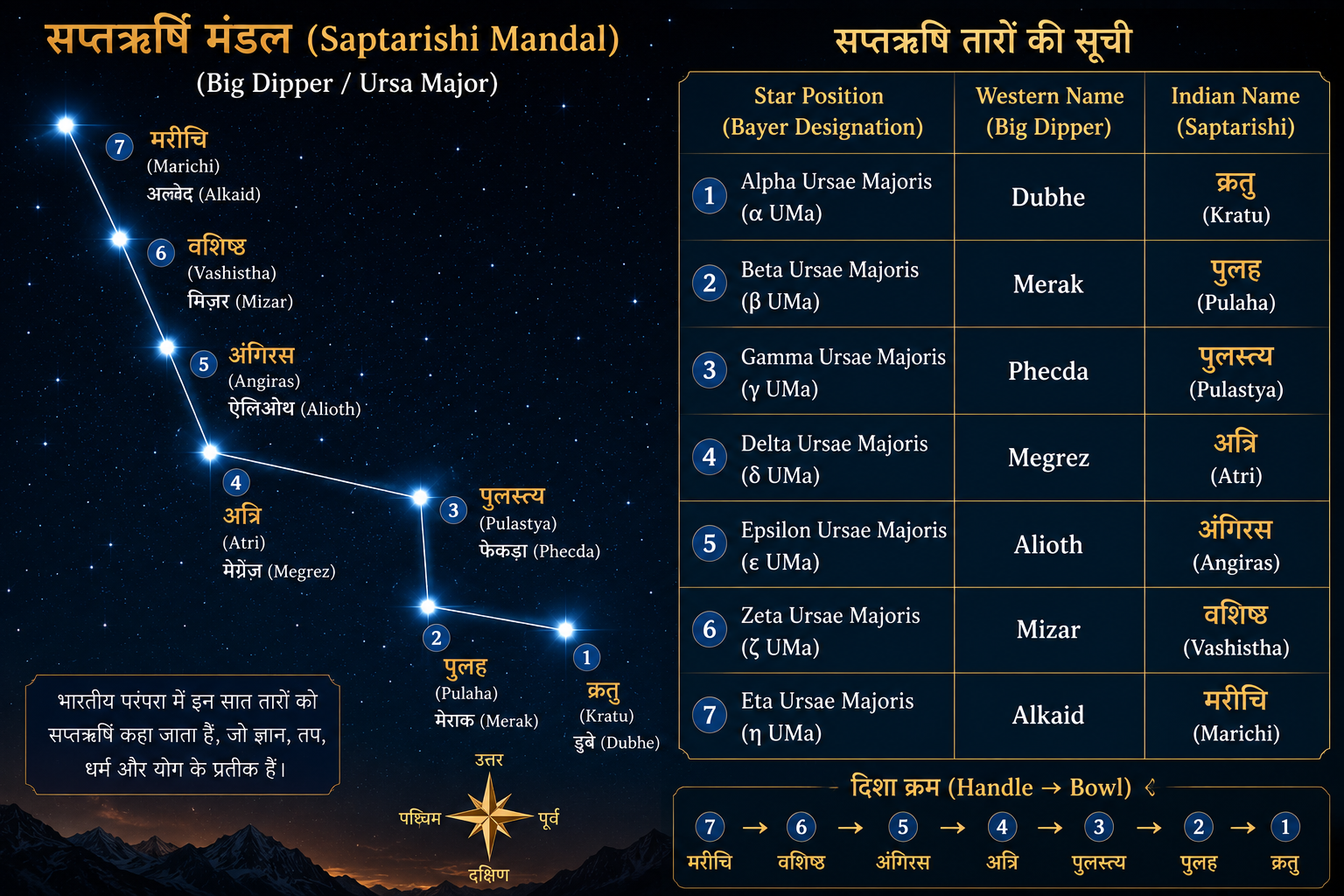
Saptarishi Mandala: The Cosmic Map

The Saptarishi Mandala (Big Dipper) constellation in the night sky.
The constellation Ursa Major (Big Dipper) is known as the Saptarishi Mandala. Mapping the sages to the stars was a way to align human consciousness with the cosmic order:
Star (Ursa Major)Rishi
DubheKratu
MerakPulaha
PhecdaPulastya
MegrezAtri
AliothAngiras
MizarVasistha
AlkaidMarichi

Section

Significance and Benefits of the Saptarishi Mandala

In Indian tradition, the Saptarishi Mandala is not just an astronomical cluster but a source of profound guidance. Its benefits span several dimensions:
  1. Universal Navigation & Timekeeping: Historically, the Saptarishis have been the primary reference for navigation. By locating the Dhruva Tara (Pole Star) through the first two stars (Kratu and Pulaha), travelers and sailors maintained their course. It also acts as a cosmic clock, indicating the change of seasons and larger cosmic cycles (Yugas).
  1. Spiritual Alignment: Viewing the constellation with awareness is said to align one’s internal energy with the Rta (Cosmic Order). It reminds the seeker of the vastness of consciousness and the presence of the eternal seers who guard human wisdom.
  1. Cultural Continuity: The Saptarishis are considered the mind-born sons of Brahma, appearing at the start of every Manvantara to restore Dharma. Their presence in the sky serves as a constant reminder of the cyclic nature of time and the immortality of the soul.

Section

Perspective: Tradition vs. Symbolism vs. History

To understand the Saptarishis fully, we must look through three lenses:
PerspectiveCore Message
Yogic TraditionAdiyogi transmitted yoga to the Saptarishis at Kanti Sarovar.
SymbolicSaptarishis represent the seven layers of human consciousness.
HistoricalVedic sages who preserved knowledge through oral tradition (UNESCO Heritage).

Section

Timeline of Transmission

The journey of yoga across time can be summarized as follows:
EraEvent
Yogic LoreOriginal Transmission by Adiyogi
Vedic PeriodFormulation of Hymns and Sage Traditions
Upanishadic PeriodShift towards Internal Mastery and Non-Duality
Classical PeriodPhilosophical Expansion and Codification (e.g., Mahabharata)
Modern EraGlobal Reach and Scientific Integration

Section

Why the Story Matters Today

The global reach of yoga and its relevance in the modern world.
The story of the Saptarishis reminds us that yoga is a complete science, not just physical exercise. It highlights the importance of a structured lineage and the evolution of human consciousness.

Section

Conclusion

The Saptarishis represent the original network of human knowledge. By taking yoga from the Himalayas to the plains of habitation, they ensured that the path of self-realization remained open to all. Their legacy continues to invite us toward awareness, discipline, and inner balance.

References used for the editorial direction