Back to Ayurveda

Ayurveda

Who Is Healthy?

A bilingual exploration of the Ayurvedic definition of health from the Sushruta Samhita, comparing it with the WHO definition and philosophical traditions from Aristotle to the Stoics.

Ayurvedic definition of health — the Sushruta Samhita verse on what it means to be truly healthy, comparing WHO and Ayurvedic perspectives.
Fixed formatEnglish / हिंदीTable of contentsVerse + meaning

Editorial

Ask most people what it means to be healthy, and the answer comes quickly: 'not being sick.' The absence of disease has been the default definition of health for centuries. But Ayurveda: centuries before the WHO defined health as a state of balance across body, mind, senses, and spirit. One verse from the Sushruta Samhita captures it all.

Sage of Action:

The truly healthy person is not merely the one without disease — but the one whose doshas are balanced, whose digestion is strong, whose mind is cheerful, and whose self is established in its own nature.

Ancient verse

Sushruta Samhita, Sutrasthana 15.48

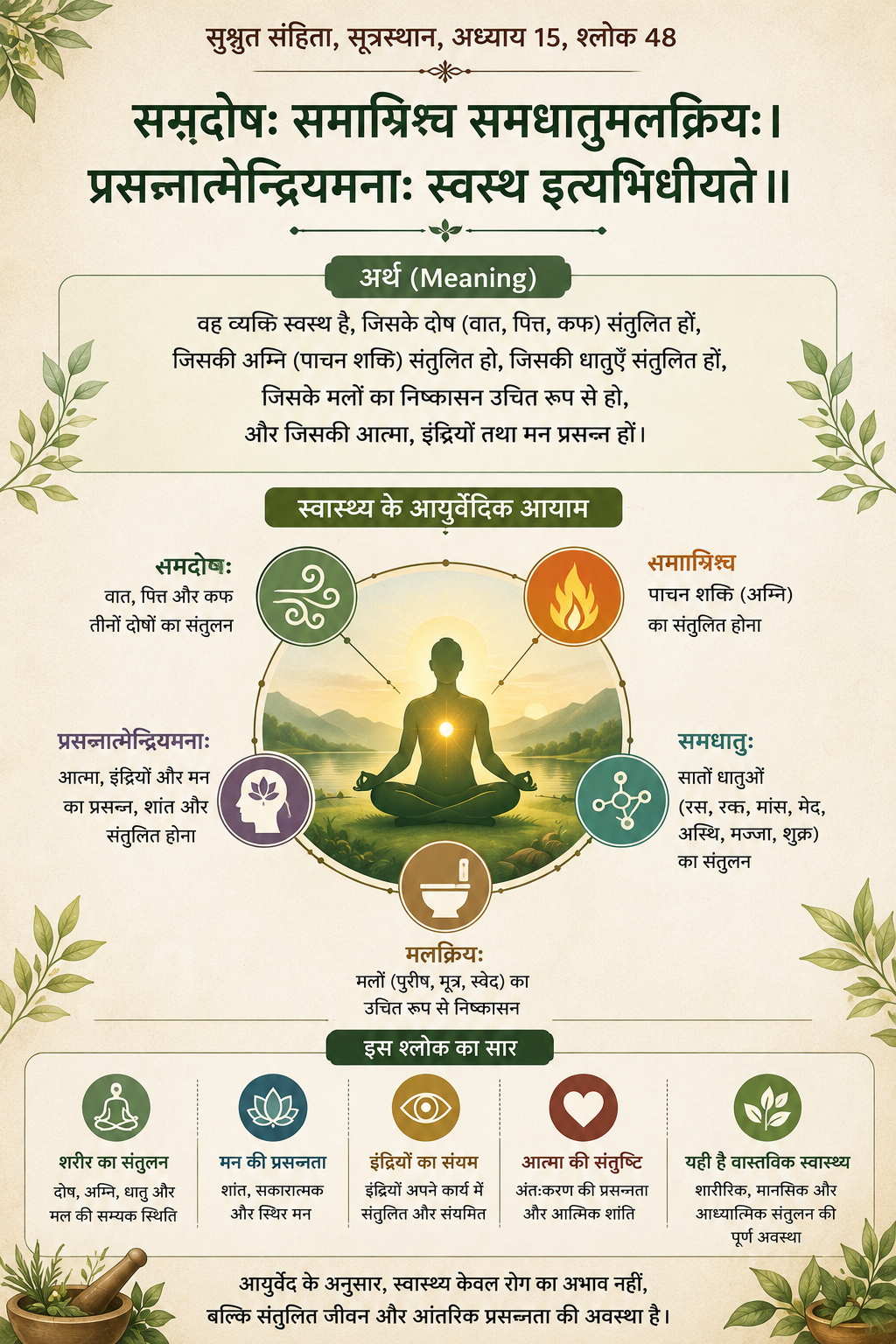
समदोषः समाग्निश्च समधातुमलक्रियः। प्रसन्नात्मेन्द्रियमनाः स्वस्थ इत्यभिधीयते॥

samadoṣaḥ samāgniśca samadhātumalakriyaḥ | prasannātmendriyamanāḥ svastha ityabhidhīyate ||

Meaning in English

That person is healthy whose doshas are balanced, whose digestive fire is balanced, whose tissues (dhatus) and waste products (malas) function normally, and whose atman (self), senses (indriya), and mind (manas) are cheerful — such a person is called swastha (healthy).

This verse from the Sushruta Samhita is one of the most concise and complete definitions of health in any medical tradition. It integrates physical, physiological, and psychological dimensions into a single measurable framework.

Section

A simple question with no simple answer

Ask most people what it means to be healthy, and the answer comes quickly: 'not being sick.' The absence of disease has been the default definition of health for centuries, both in common understanding and in mainstream medicine. A person with normal lab reports, no diagnosed condition, and no physical complaints is considered healthy.
But this definition breaks down under scrutiny. Consider the corporate employee who passes every health checkup but wakes exhausted every morning, lives with chronic stress, feels no enthusiasm for life, and is consumed by anxiety. Consider the student crushed by academic pressure, or the homemaker who cares for everyone except herself. Their medical reports say 'normal.' Their lived experience says otherwise.
This gap between clinical normality and genuine well-being has driven physicians, philosophers, and thinkers across cultures to ask a deeper question: what does health really mean?

Section

The WHO definition: an important step

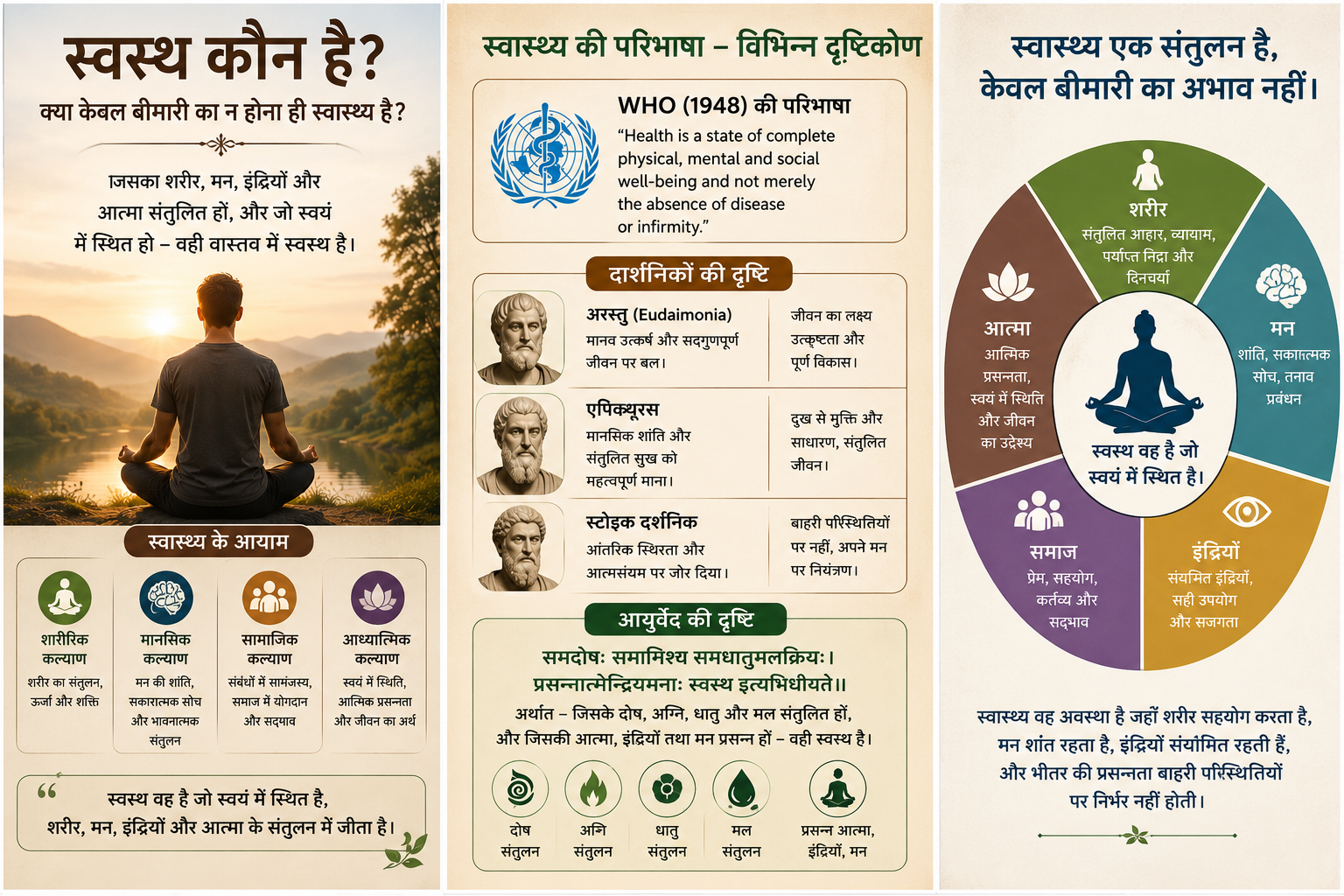
Modern medicine, for most of its history, operated on a disease-centred model. A patient was healthy if no pathology could be found. It took the founding of the World Health Organization in 1948 to formalise a broader view. The WHO Constitution defined health as "a state of complete physical, mental and social well-being and not merely the absence of disease or infirmity."
For its time, this was a revolutionary statement. It acknowledged what clinicians had long observed: that patients could be disease-free yet unwell. It brought mental and social dimensions into the definition of health for the first time at an institutional level.
Yet the WHO definition is not without its critics. Researchers have pointed out that the word 'complete' sets an unattainable standard no one experiences complete well-being in all three domains at all times. A person might have excellent physical health and strong social connections yet still feel a sense of inner restlessness or lack of purpose. Does that make them unhealthy?

Section

Philosophical perspectives on human flourishing

Long before the WHO, philosophers across traditions grappled with what constitutes a good human life. Aristotle's concept of eudaimonia — often translated as 'human flourishing' held that true well-being comes from living in accordance with virtue and realising one's full potential. For Aristotle, health was inseparable from purpose and ethical living.
Epicurus taught that the highest good was pleasure, but by this he meant not sensual indulgence but a state of tranquillity (ataraxia) achieved through modest living, friendship, and the absence of fear. The Stoics, from Zeno to Marcus Aurelius, emphasised inner stability, self discipline, and the ability to remain undisturbed by external events — a philosophy of psychological resilience that has seen a revival in modern cognitive behavioural therapy.
Each of these traditions identified important dimensions of human well-being. But none integrated these insights into a practical, testable framework for health that could be applied by physicians and individuals alike. That integration came from a different tradition entirely.

Section

Ayurveda's definition of health: the Sushruta Samhita

Sushruta Samhita, Sutrasthana 15.48 — the Sanskrit verse defining health as balance of doshas, agni, dhatus, malas, and a cheerful state of atman, senses, and mind.
Ayurveda, the ancient Indian system of medicine, approached health not as the absence of disease but as a state of dynamic equilibrium. Its most concise and powerful expression of this philosophy appears in a single verse from the Sushruta Samhita, one of the foundational texts of Ayurvedic surgery and medicine, attributed to the physician-sage Sushruta (c. 600 BCE–100 CE):

Section

The six pillars of health in Ayurveda

The verse identifies six distinct factors that collectively define health. Each is measurable and clinically significant:
Samadosha: The three doshas — Vata, Pitta, and Kapha — are in equilibrium. In Ayurvedic physiology, these are the biological humours that govern all physiological and psychological processes. When they are balanced, the body functions optimally. When they are disturbed, disease begins.
Samagni: The digestive fire is balanced. Agni is not merely digestion in the stomach but all metabolic transformations in the body. Balanced agni means the body can properly convert food into energy and tissue. Impaired agni is considered the root cause of most diseases in Ayurveda.
Samadhatu and samalakriya: The seven dhatus (tissues — plasma, blood, muscle, fat, bone, marrow, and reproductive fluid) are formed correctly, and the three malas (waste products — urine, faeces, sweat) are eliminated properly. This covers both structural integrity and excretory function.
Prasannatmendriyamanah: The atman (self or spirit), indriyas (senses), and manas (mind) are cheerful or content. This is the most remarkable part of the definition — it explicitly includes subjective well-being, sensory clarity, and mental peace as essential components of health.
Section

Swastha: established in the Self

The Sanskrit word for health used in the verse — swastha — carries its own philosophical depth. It is formed from two roots: sva (self, one's own) and stha (established, situated). The healthy person, in this view, is one who is established in their own self — in harmony with their own nature.
This etymological insight transforms health from a clinical category into a way of being. It is not merely a condition to be maintained but a state of alignment: the body functions without obstruction, the mind remains clear and calm, the senses perceive without distortion, and the inner self experiences contentment that does not depend on external circumstances.
In this framework, a person can be healthy even while facing challenges, and a person can be clinically disease-free yet not truly swastha. The definition accounts for what the WHO definition misses: the dimension of inner fulfilment.

Section

Why this matters today

The limitations of a purely biomedical model of health are now widely recognised. Chronic stress, anxiety, burnout, and lifestyle diseases are among the greatest health challenges of the 21st century — and none of them are captured by a definition that only asks, 'Is there a disease?'
Modern movements in medicine — from lifestyle medicine and functional medicine to integrative health — are rediscovering what Ayurveda articulated centuries ago: that health is a multidimensional state of balance, not a binary between sick and not sick. The growing interest in mind-body interventions, personalised nutrition, stress management, and preventive wellness reflects a convergence toward the Ayurvedic worldview.
The WHO definition was a milestone, but it remains incomplete. A complete definition of health must account not only for physical, mental, and social well-being but also for the quality of consciousness the inner state of the person. Ayurveda's swastha framework offers exactly this.

Section

Conclusion

So who is truly healthy?
Not merely the person without disease. Not even the person with a strong social network and a sound mind. According to Ayurveda, the truly healthy person is one whose body is in balance, whose digestion is strong, whose tissues are well-formed, whose waste elimination is regular, and whose self, senses, and mind are cheerful.
It is a definition that is at once practical and profound, clinical and philosophical. It sets a high standard — but it also gives a clear direction. Health, in this view, is not the absence of something. It is the presence of balance, clarity, and inner contentment. It is being established in the self.
That is what swastha truly means.

References used for the editorial direction