Back to Yoga

Saptarishis in the Vedas and Upanishads: A Documentary Exploration

A deep documentary-style investigation into where the Saptarishis appear in the Vedas, Upanishads, Brahmanas, and Puranas — revealing how the concept evolved from inspired poets to cosmic archetypes.

The Seven Sages (Saptarishis) as described in the Vedas and Upanishads.
Fixed formatEnglish / हिंदीTable of contentsVerse + meaning

Editorial

Where exactly are the Saptarishis mentioned in the Vedas and Upanishads? The answer is not as straightforward as most assume — and that is precisely what makes this journey fascinating.

Sage of Action:

Truth does not require a fixed list to be real; it reveals itself through layers of inquiry, across ages of human seeking.

Ancient verse

Vishnu Purana — Traditional Puranic Enumeration of the Saptarishis

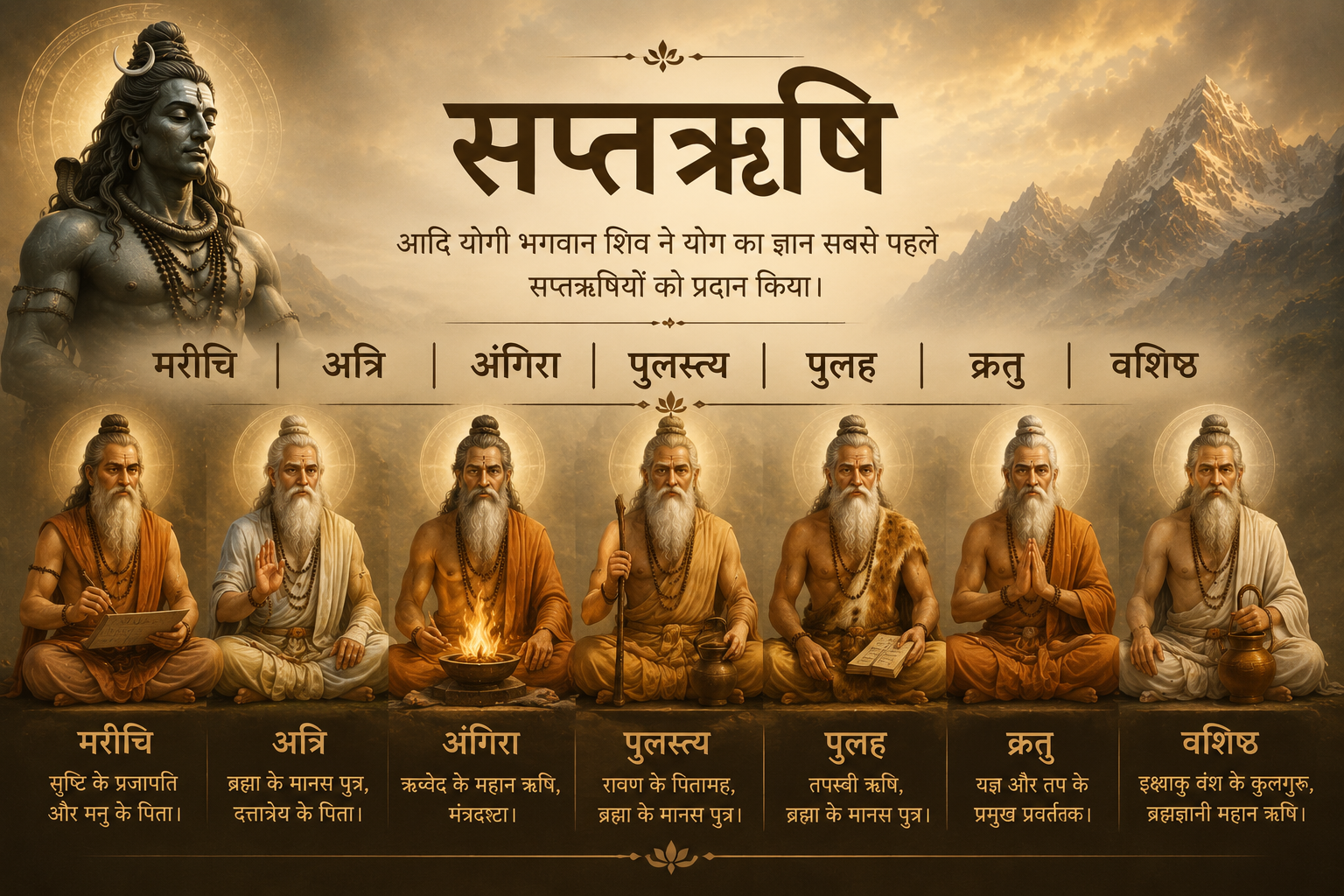
मरीचिरत्रिरङ्गिराश्च पुलस्त्यः पुलहः क्रतुः। वसिष्ठश्च महातेजाः सप्तर्षयः प्रकीर्तिताः॥

marīcir atrir aṅgirāś ca pulastyaḥ pulahaḥ kratuḥ | vasiṣṭhaś ca mahātejāḥ saptarṣayaḥ prakīrtitāḥ ||

Meaning in English

Marichi, Atri, Angiras, Pulastya, Pulaha, Kratu, and the illustrious Vasistha are celebrated as the Seven Sages.

This verse from the Vishnu Purana presents the best-known traditional list of the Seven Sages for the current Vaivasvata Manvantara.

Section

Introduction: The Quest Begins

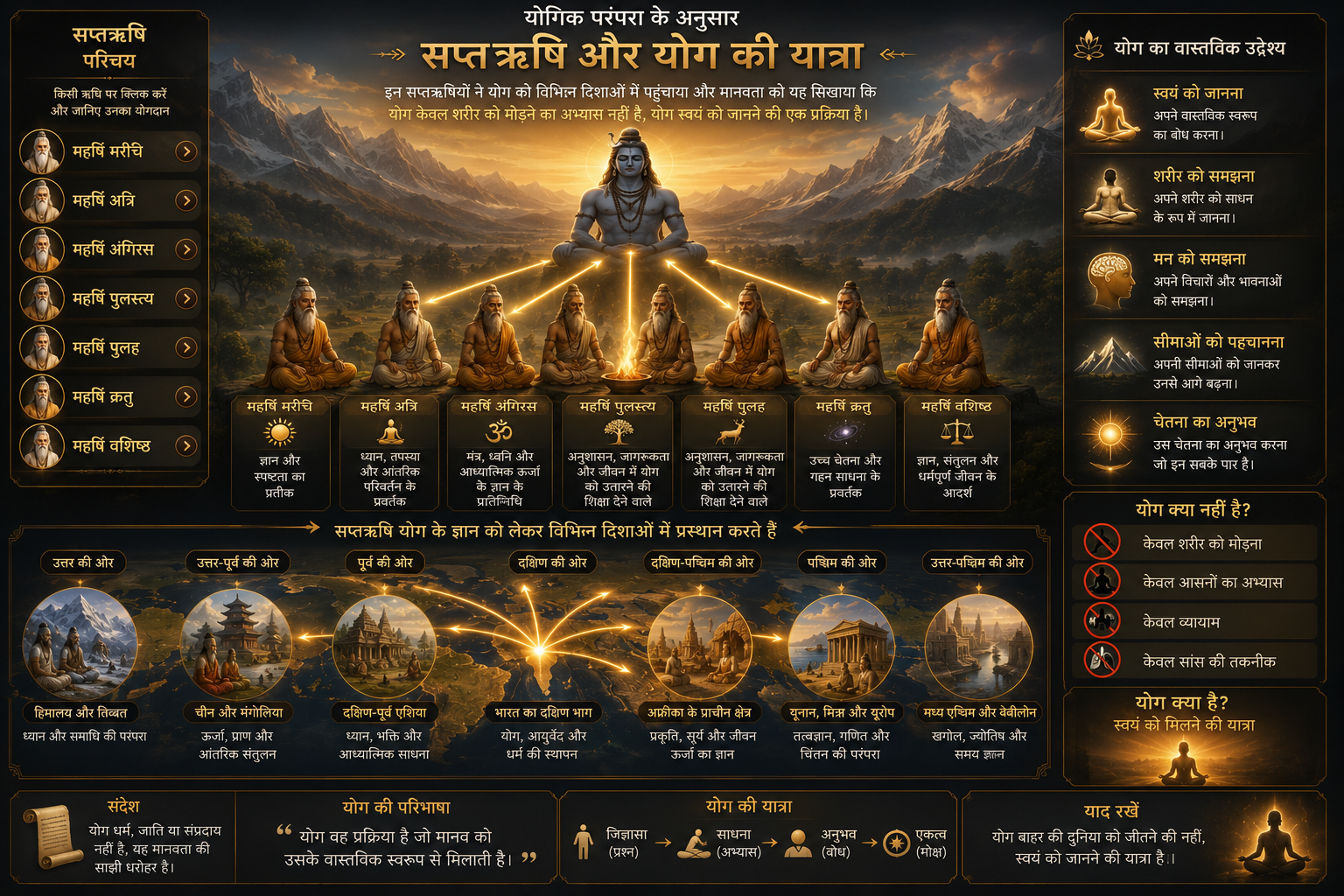
Adiyogi Shiva teaching the seven sages in a meditative setting in the Himalayas.
If the Saptarishis are so central to Indian tradition — the guardians of cosmic knowledge, the original recipients of yoga — then surely their names must appear clearly in the oldest scriptures, listed in order, waiting to be discovered.
But the truth is more nuanced. The four Vedic Samhitas (Rigveda, Yajurveda, Samaveda, Atharvaveda) do not present the familiar Puranic list of the Saptarishis — Marichi, Atri, Angiras, Pulastya, Pulaha, Kratu, and Vasistha — as a single named group. Instead, they mention many individual Rishis and several prominent Rishi lineages. The idea of a fixed list of seven sages develops gradually in later Vedic and post-Vedic literature.
This tells us something profound about how the Indian tradition preserved and transformed knowledge across millennia. This article is a documentary-style journey through the scriptures to trace the Saptarishis from the Vedas to the Puranas, uncovering the layers of meaning accumulated over thousands of years.

Section

Editorial Note

Ancient Indian texts were composed over many centuries and belong to different literary traditions. Where multiple interpretations exist, this article presents the most widely accepted scholarly understanding while acknowledging alternative traditions. The Sanskrit quotations cited have been verified against critical editions where available.

Section

Who Were the Rishis in the Rigveda?

The ancient seers of the Rigveda — the mantra-drashtas.
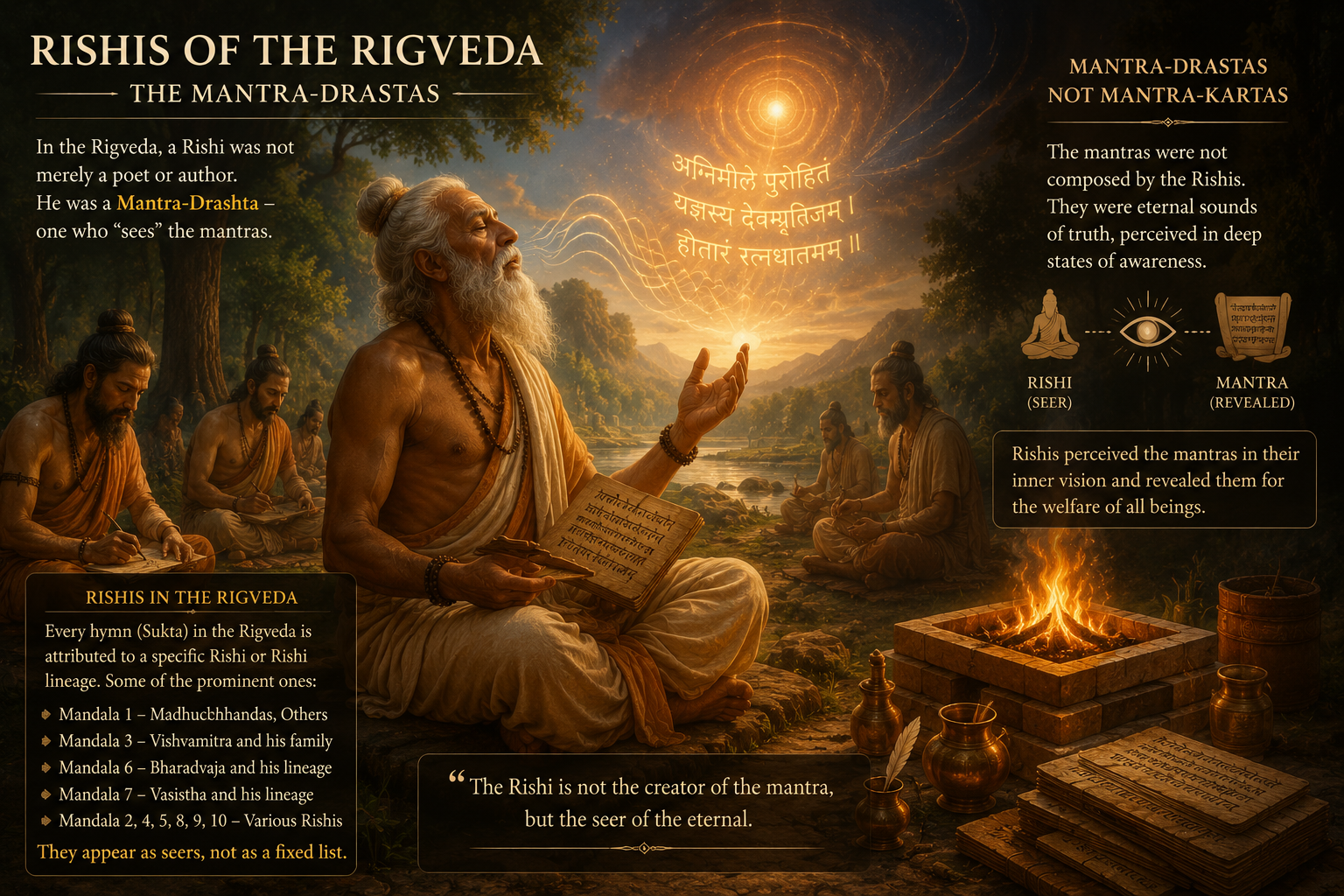
To understand the Saptarishis, we must first understand what a "Rishi" meant in the Vedic age. Today the word conjures images of long-bearded ascetics meditating in forests. But in the Rigveda, a Rishi was something far more specific: a Mantra-Drashta — one who "sees" the mantras.
The Vedic belief was that certain sounds of truth have always existed in the universe. They were not composed or invented — they were revealed. And the Rishis were those whose consciousness had become so purified that they could perceive these eternal vibrations.
This is why every hymn (Sukta) in the Rigveda is attributed to a specific Rishi or Rishi lineage. Mandala 7 belongs primarily to Vasistha. Mandala 3 to Vishvamitra. Mandala 6 to the Bharadvaja clan. These names exist in the Vedas — but not as a fixed list. They appear as authors, as lineages, as the human channels through which cosmic knowledge flowed.

Section

Why the Number Seven?

The sacred number seven in Vedic cosmology.
If the Vedas mention many Rishis, why did the number seven become so significant? In Vedic literature, the number "seven" (Sapta) appears repeatedly as a sacred number — not just for sages, but across the entire fabric of existence.
Sapta Sindhavah — the seven rivers. Sapta Svara — the seven musical notes. Sapta Ranga — the seven colors of the rainbow. The Rigveda contains references to "seven sages" (e.g., Rigveda 9.107.18), but it does not provide a fixed list of their names. The Sapta Rishis were not seven specific individuals from the beginning. They were a concept — a recognition that wisdom manifests through multiple fundamental dimensions.
This distinction is crucial. The Vedic mind thought in archetypes, not just in historical figures. The number seven represented completeness — the full spectrum of human wisdom.

Section

The Brahmanas: Rishis Become Stars

The Saptarishi Mandala (Ursa Major) constellation — the seven sages mapped to the stars.
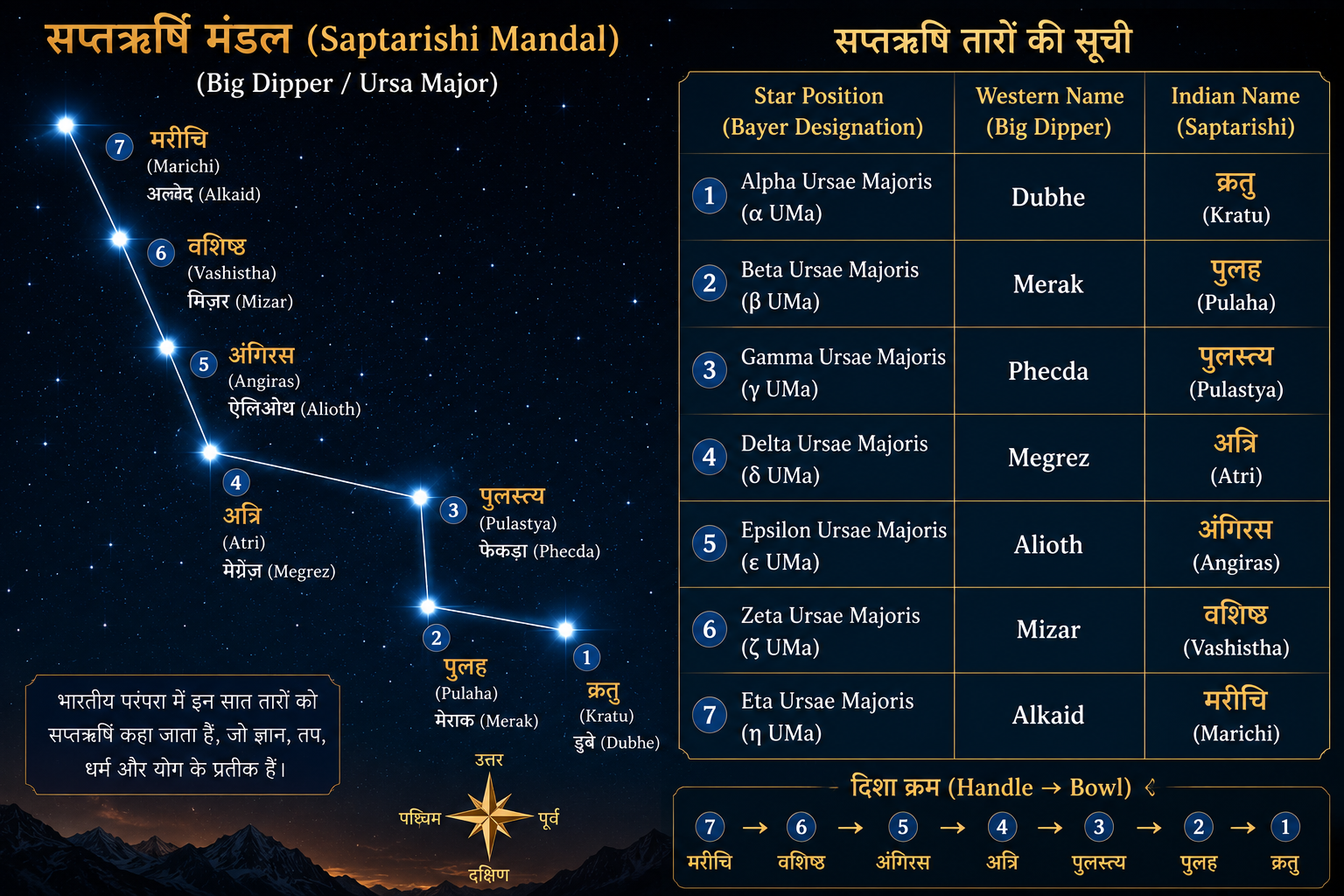
By the time of the Brahmana literature (c. 900–700 BCE), the tradition had strongly associated the Seven Sages with the seven prominent stars of Ursa Major, giving rise to the concept of the Saptarishi Mandala. A commonly cited line from the Shatapatha Brahmana — "Saptarshayah purve asan te ime nakshatreshu drishyante" (the seven sages existed in primordial times; they are now seen in the constellations) — reflects this association, though its precise attribution remains debated.
Whether the celestial symbolism inspired the tradition or reflected an already existing concept remains a subject of scholarly interpretation.
Nevertheless, this association represents a profound understanding: human wisdom as a reflection of cosmic order. The Rishis, who had realized this unity, were seen not just as historical teachers but as living presences in the cosmos.

Section

The Seven Stars and Their Traditional Mappings

Mapping of each star in the Saptarishi Mandala to a specific Rishi.
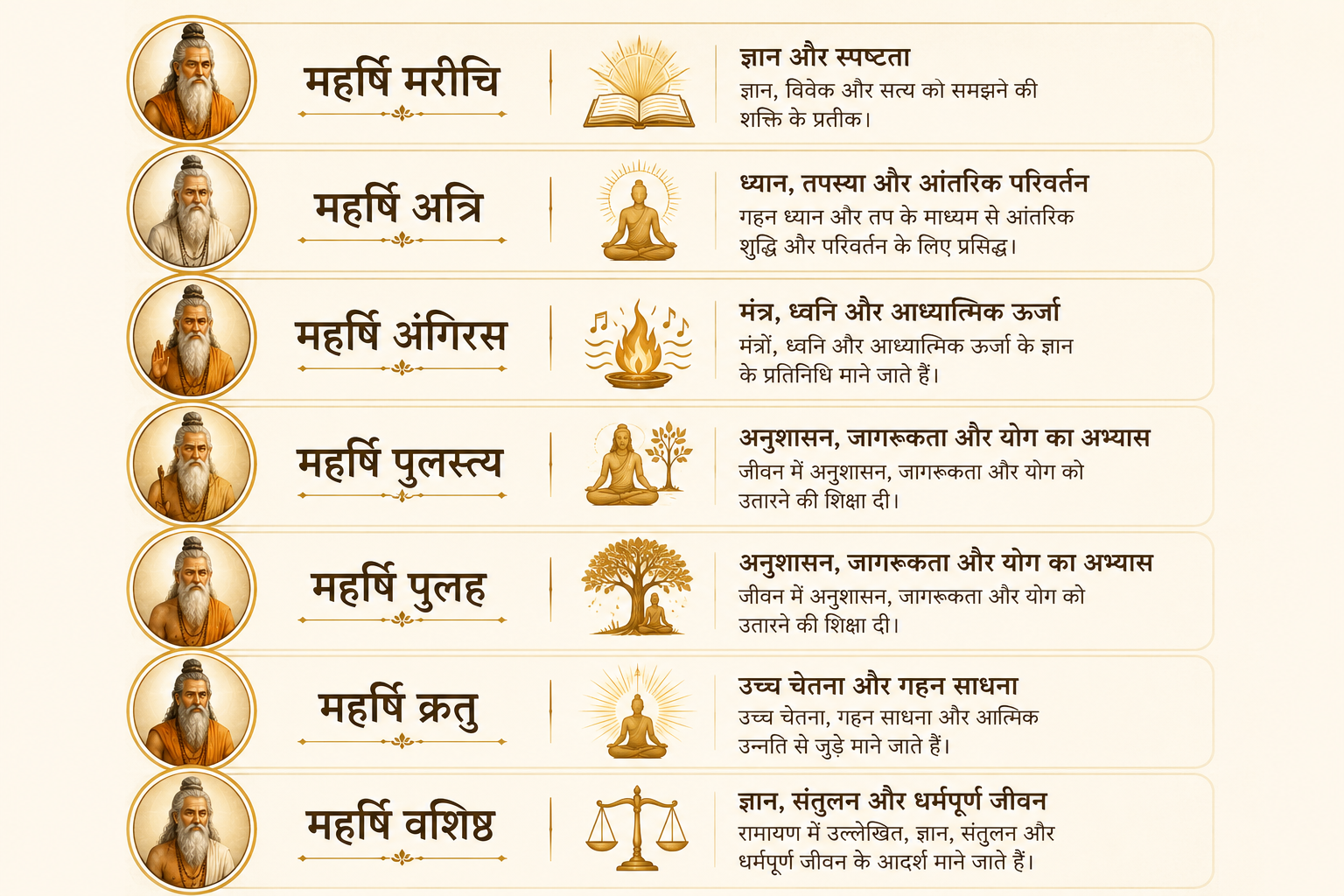
The mapping of individual stars to specific Rishis developed over time. The correspondence shown below represents one traditional mapping; other regional and textual traditions differ:
Star (Ursa Major)Traditional RishiSymbolic Association
Dubhe (α UMa)KratuAction and sacrifice
Merak (β UMa)PulahaConcentration and focus
Phecda (γ UMa)PulastyaDiscipline and ethics
Megrez (δ UMa)AtriMeditation and inner transformation
Alioth (ε UMa)AngirasMantra and sound energy
Mizar (ζ UMa)VasisthaKnowledge, balance, and righteousness
Alkaid (η UMa)MarichiLight, discernment, and wisdom
This celestial mapping served multiple purposes. It was a memory system — the sky became a living library of knowledge. It was a navigation system — the Saptarishi Mandala helped travelers locate the Pole Star (Dhruva Tara). And it was a spiritual reminder.

Section

The Upanishads: Rishis Come Alive

The living tradition of the Upanishads — Rishis in dialogue, seeking truth.
When we move from the Brahmanas to the Upanishads, the Rishis undergo a remarkable transformation. They are no longer just names in a lineage or stars in the sky. They become living, breathing participants in the greatest philosophical dialogues ever recorded.
In the Brihadaranyaka Upanishad, we meet Yajnavalkya — not as a distant sage, but as a sharp, confident teacher sitting in King Janaka's court. The brilliant philosopher Gargi Vachaknavi challenges him with relentless questions about the ultimate foundation of reality. The discussion culminates in the teaching of the Akshara (the Imperishable) — revealing the Upanishadic shift from ritual toward metaphysical inquiry.
Yajnavalkya's famous declaration — "Ayam Atma Brahma" (This Self is Brahman) — is one of the four great Mahavakyas (great sayings) of the Upanishads, though in the narrative it is delivered in a different context. The Gargi-Yajnavalkya debate specifically explores the nature of the Imperishable ground of all existence (Brihadaranyaka Upanishad 3.8).
The Brihadaranyaka Upanishad is also significant for preserving one of the earliest clear enumerations of seven sages: Atri, Bharadvaja, Gautama, Jamadagni, Kashyapa, Vasistha, and Vishvamitra (Brihadaranyaka Upanishad 2.2.4). This list differs from the later Puranic list — a difference that reflects the evolution of the tradition rather than any contradiction.
In the Chandogya Upanishad, we see Narada approaching Sanatkumara with a confession: "Adhīto'smi bhagavo mantrān" — I have studied all the Vedas, O Lord. Rigveda, Yajurveda, Samaveda — everything. But I have not attained peace.
This moment remains as true today as it was thousands of years ago. Knowledge without inner peace is incomplete. And this is precisely what the Upanishadic Rishis teach us — the goal is not information, but transformation.
The Upanishads do not give us a fixed list of seven sages. Instead, they show us the Rishi as a living category — anyone who has seen the truth, who lives in awareness, who questions relentlessly. The Rishi is not a figure from the past. The Rishi is a state of being.
Section

A Brief Timeline of the Saptarishi Tradition

The development of the Saptarishi concept across Indian literary history can be traced approximately as follows:
PeriodDevelopment
Rigveda (c. 1500–1200 BCE)Individual Rishis and lineages; concept of "seven sages" without fixed names
Brahmanas (c. 900–700 BCE)Seven sages linked to ritual and to the constellation Ursa Major
Upanishads (c. 800–300 BCE)Brihadaranyaka Upanishad gives first clear list; Rishis as living philosophers
Itihasa-Purana (c. 400 BCE–400 CE)Expanded narratives; Puranas formalize Saptarishi lists for each Manvantara
This timeline is approximate. Indian texts were composed over many centuries, and dating them precisely remains a subject of scholarly debate.

Section

Why Do Different Scriptures Give Different Lists?

A reader who consults multiple scriptures will notice that the names of the Saptarishis are not consistent across texts. This is not an error — it is one of the most important features of the tradition.
The answer lies in two factors. First, the Saptarishi tradition evolved over time: the Rigveda mentions individual Rishis and Rishi families; the Brahmanas describe seven sages as a group; the Upanishads present philosophical lineages; and the Puranas introduce the Manvantara system.
Second, Hindu cosmology holds that time is cyclical. Each great cycle (Kalpa) is divided into fourteen Manvantaras (ages of Manu). Each Manvantara has its own set of seven sages. The Saptarishis of one cosmic age are different from those of another — meaning the Saptarishi is not a fixed set of individuals but a position, a sacred office.
Different Puranas preserve different lists for the current Manvantara (Vaivasvata Manvantara), reflecting the diversity of regional and textual traditions:
SourceSaptarishi List
Vishnu PuranaMarichi, Atri, Angiras, Pulastya, Pulaha, Kratu, Vasistha
Mahabharata (Puranic section)Marichi, Atri, Angiras, Pulastya, Pulaha, Kratu, Vasistha
Brihadaranyaka UpanishadGotama, Bharadvaja, Vishvamitra, Jamadagni, Vasistha, Kashyapa, Atri
The Brihadaranyaka Upanishad preserves the first clear list of seven sages in surviving literature, while later Puranas provide lists organized under the Manvantara framework. This reflects the evolution of the tradition over time — not a contradiction.
Far from being a problem, this diversity is characteristic of the Indian tradition — a tradition that understood that truth expresses itself differently across ages, and that wisdom must be adapted to the needs of each era.

Section

Gargi and Yajnavalkya: The Living Face of Inquiry

Gargi Vachaknavi, the great female philosopher of the Upanishads, challenging Yajnavalkya.
Among the most powerful episodes in the Upanishads is the Brahmayajna of King Janaka — a great philosophical tournament where the brightest minds gathered. Yajnavalkya, the confident sage, had already answered several challengers. Then Gargi Vachaknavi stood up.
She asked the deepest questions possible — about the very fabric of reality. She pressed Yajnavalkya to define the imperishable ground of all existence. The dialogue culminates not in a formula but in a recognition: beyond the visible world lies the Akshara, the Imperishable, which cannot be described but can be realized (Brihadaranyaka Upanishad 3.8).
This episode reveals something profound about the Rishi tradition. It was not a closed male club. It was a living ecosystem of inquiry where women like Gargi and Maitreyi were not just participants but leading voices. The Rishi was defined by the depth of their seeking, not by their gender or birth.

Section

Conclusion: The Saptarishi Is Not a Person — It Is a Position

The global transmission of yogic wisdom across time and space.
The journey through the scriptures reveals a profound truth: the Saptarishi is not a fixed list of seven names from the distant past. It is a position — a sacred office held by different beings in different ages.
The Vedas gave us the archetype of seven. The Brahmanas connected it to the stars. The Upanishads brought the Rishis to life as living seekers. And the Puranas provided names — names that change across Manvantaras because the office itself is eternal.
What remains constant across all these layers is not the names, but the function: the preservation and transmission of wisdom. Whether as Mantra-Drashtas in the Rigveda, as cosmic guardians in the Brahmanas, as living philosophers in the Upanishads, or as named sages in the Puranas — the Saptarishis represent humanity's highest potential: the capacity to see truth, live it, and pass it on.
The next time you look at the seven stars in the northern sky, remember: you are not just looking at a constellation. You are looking at a tradition that has kept the flame of knowledge alive for thousands of years. And that flame is still burning — waiting for the next seeker to carry it forward.

References used for the editorial direction