Back to Yoga

The Unbroken Lineage: A Journey Through Yoga’s History

An original exploration of yoga’s evolution, from its mythic beginnings with the Adiyogi and the Great Epics to the rigorous systemization of the Hatha masters.

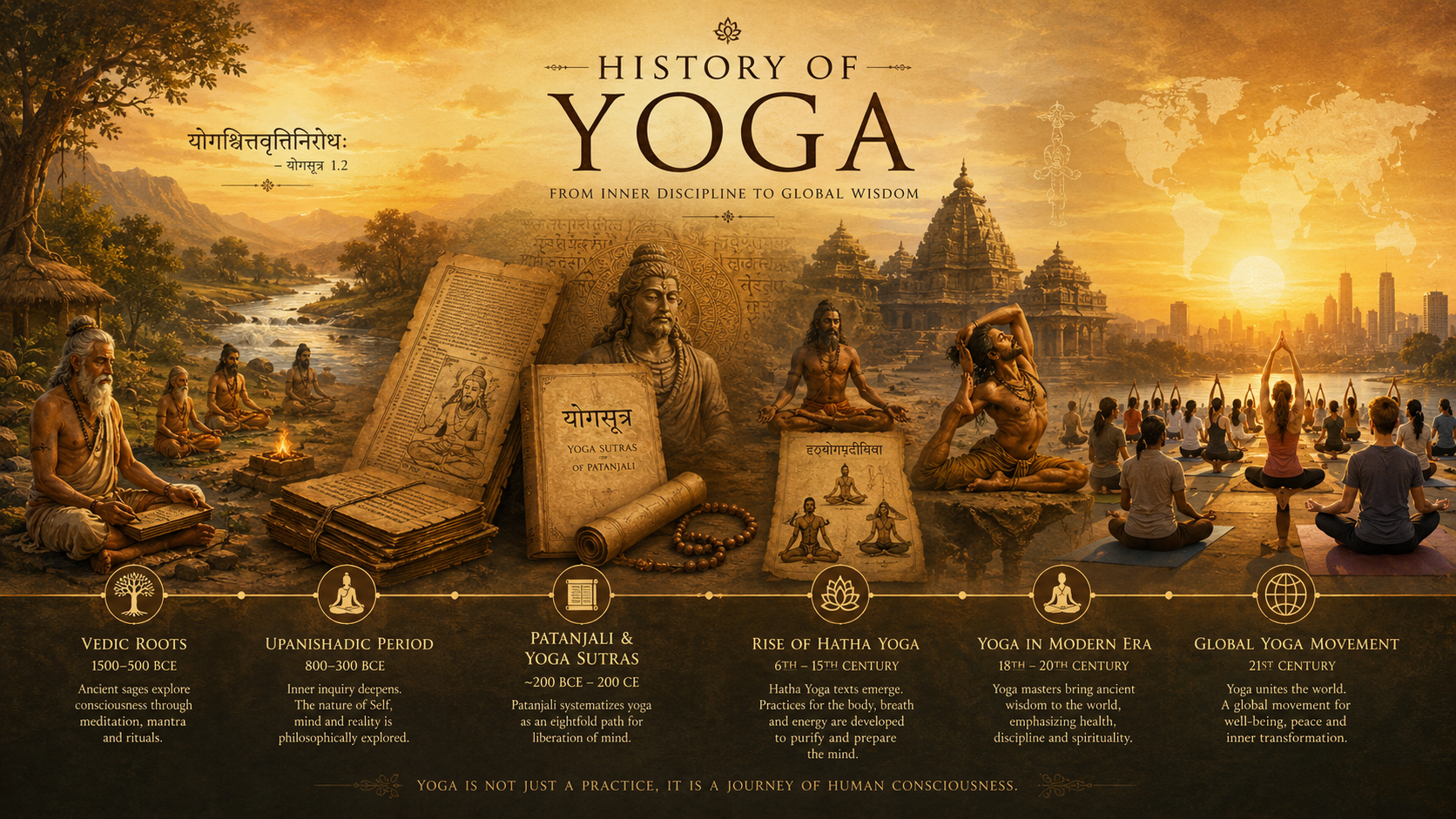
A comprehensive visual history of yoga across the ages
Fixed formatEnglish / हिंदीTable of contentsVerse + meaning

Editorial

We often treat history as a list of dead dates. But the history of yoga is a living map of how humans learned to master their own internal chaos. In my experience, yoga didn't start in a studio; it began in the profound silence of those who realized that the world outside can never be settled until the world inside is mastered. This is the story of how that mastery became a science.
Ancient verse

Yoga Sutra 1.2

योगश्चित्तवृत्तिनिरोधः।

yogaś citta-vṛtti-nirodhaḥ

Meaning in English

Yoga is the technology of stilling the erratic movements of the consciousness.

Section

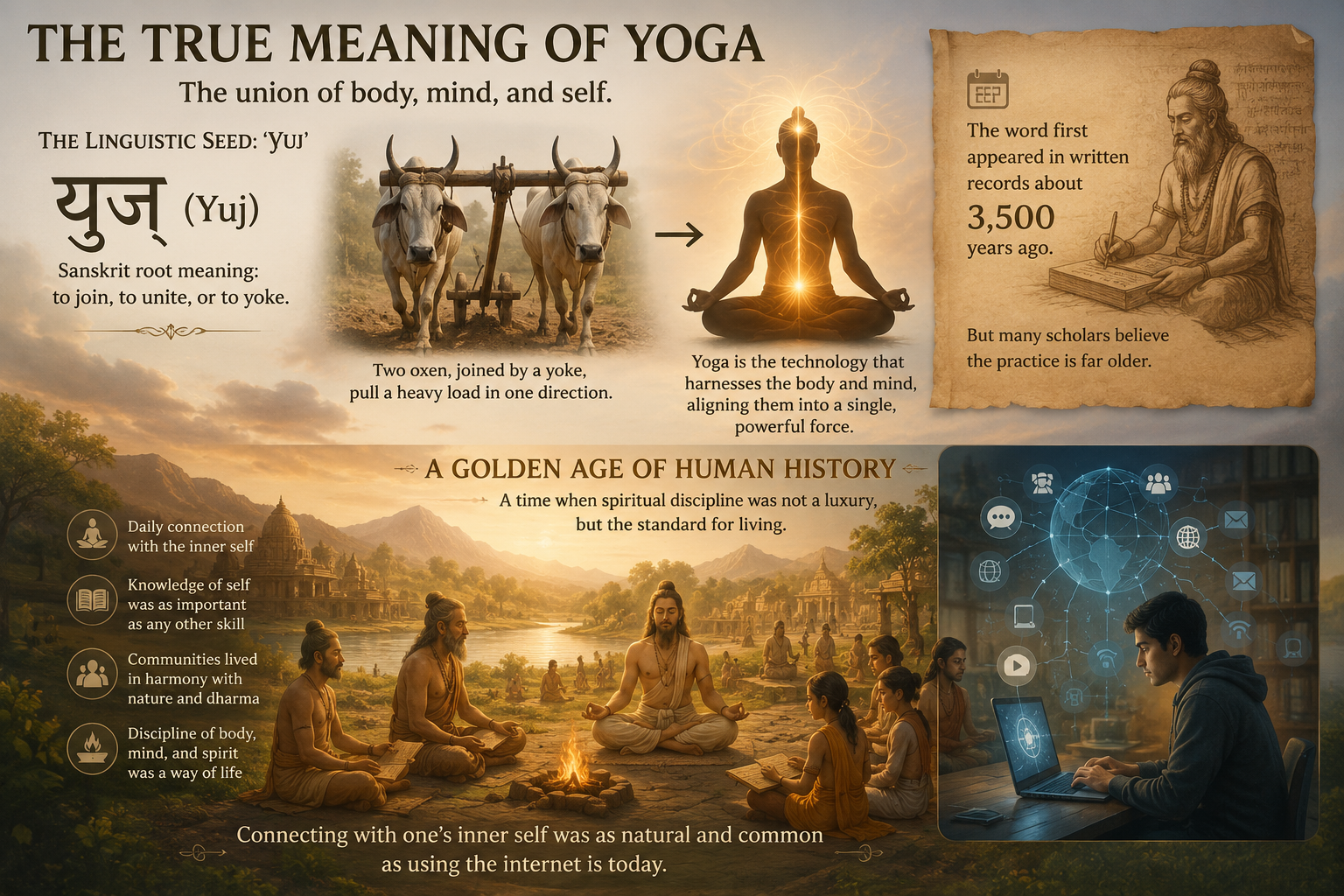
The Root of Union: What is Yuj?

Ancient representation of the Sanskrit root Yuj, signifying the union of individual and universal consciousness
To understand Yoga, we must look at its linguistic seed: the Sanskrit word 'Yuj'. It means to join, to unite, or to yoke. Think of the wooden harness used to bring two oxen together so they can pull a heavy load in a single direction. In the same way, Yoga is the technology that harnesses the body and mind, which usually pull in different directions, and aligns them into a single, powerful force.
While the word first appeared in written records about 3,500 years ago, many scholars believe the practice is far older. It belongs to a 'Golden Age' of human history: a time when spiritual discipline was not a luxury, but the standard for living. In that era, connecting with one's inner self was as natural and common as using the internet is today.

Sage of Action:

We often think ancient people were primitive, but in terms of internal technology, they were far more advanced than us. They lived in a world where the norm was awareness, not distraction.

Section

The Primeval Transmission

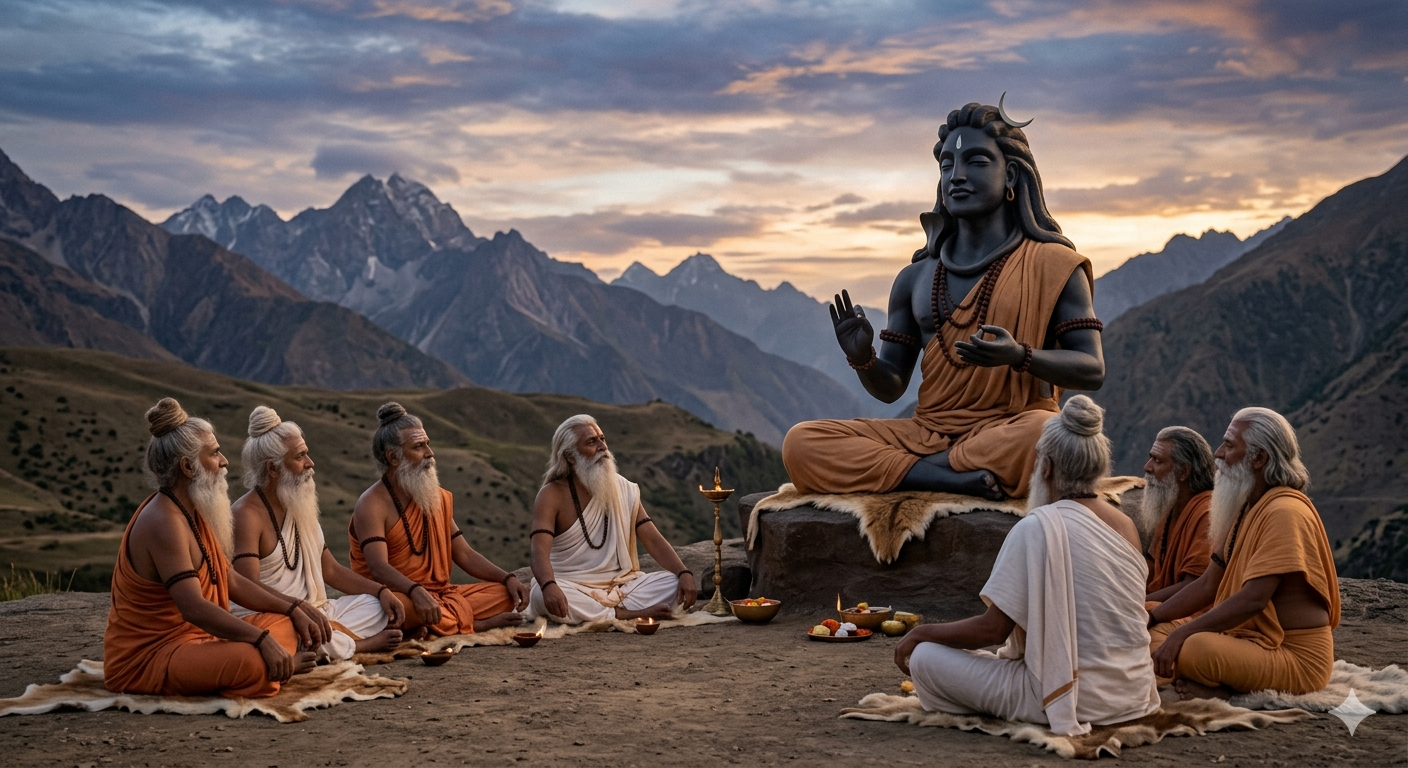
The Adiyogi Shiva sharing the secrets of consciousness with the seven seekers in the high Himalayas
In the yogic lore, the story begins not with a book, but with a transmission. Lord Shiva, as the Adiyogi, sat in the high Himalayas. He didn't offer a philosophy to be debated; he offered a method to be lived. He shared the structural secrets of human consciousness with seven dedicated seekers: the Saptarishis.

Sage of Action:

Yoga was not limited to religion; it was preserved as a method of inner transformation: a technology for the human software. It is the original manual for the soul.

Section

The Four Pillars: The Wisdom of the Vedas

Long before the written word, the foundations of yoga were heard as Sruti (divine revelation). The four Vedas: Rigveda, Samaveda, Yajurveda, and Atharvaveda form the bedrock of what we now call Yoga. These are not just collections of hymns; they are records of humanity’s first attempts to communicate with the forces of existence.
The Rigveda, the oldest of the four, uses imagery of yoking, harnessing, and disciplined alignment.

Sage of Action:

This is the most profound metaphor for the practice: the human body is the chariot, and Yoga is the skill of harnessing your internal energy to drive with purpose, rather than being pulled by the horses of desire.

These texts introduced Tapas: the heat of focused discipline. They taught that to connect with the divine, one must first cultivate an inner fire through mantra and ritual.

Section

The Inward Revolution: The Upanishads

As the Vedic era evolved, the focus shifted from outer fire rituals to the inner fire of awareness. The Upanishads, including the 13 principal ones like the Brhadaranyaka and Chandogya, acted as the key that unlocked the metaphysical secrets of the Vedas. They asked the ultimate question: 'Who am I beyond this name and body?'
It was here that the non-dual truth of Advaita was born: the realization that Atman (the individual soul) is not separate from Brahman (the infinite reality). This era turned Yoga from a ritual into a direct psychological experience. The phrase Tat Tvam Asi (Thou Art That) became the battle cry for every serious seeker.

Section

The Great Epics: Yoga in Action

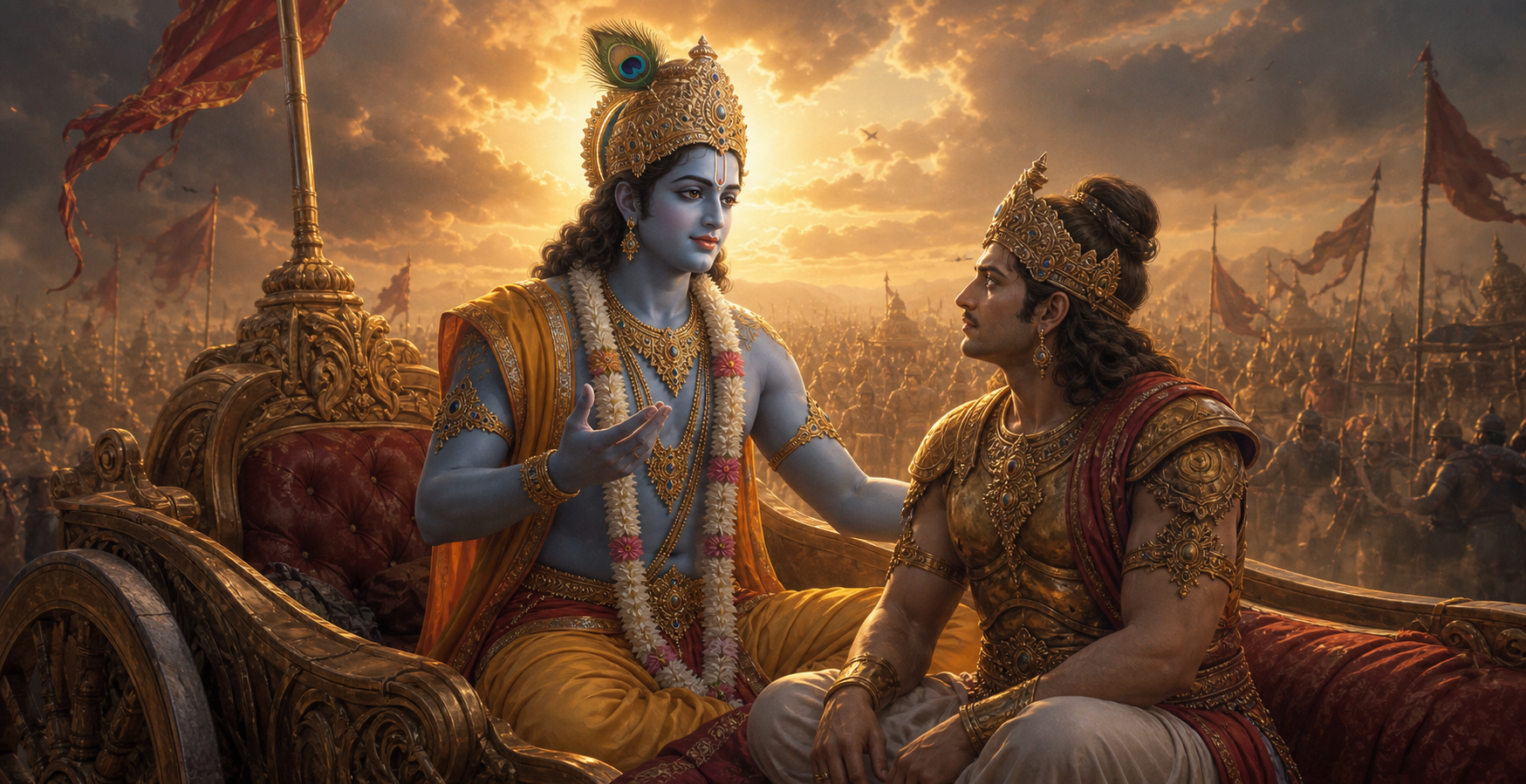
Lord Krishna delivering the discourse of the Bhagavad Gita on the battlefield
The Mahabharata and Ramayana brought yoga out of the forest and onto the battlefield of life. In the Bhagavad Gita, Krishna presents Yoga as the ultimate skill in action. He doesn't tell Arjuna to run away to the mountains; he tells him to find his center while the arrows are flying.
The Gita gave us the three major paths: Karma Yoga (Action), Bhakti Yoga (Devotion), and Jnana Yoga (Knowledge). It proved that anyone, whether a warrior, a king, or a householder, could attain self-mastery through steady awareness and doing one's duty (Dharma).
Allegorically, Rama represents the spirit (Brahman) and Sita represents the individual soul (Atman). Their journey in the Ramayana is the journey of rescuing the soul from the clutches of the ego.

Section

The Shramana Influence: Buddha and Mahavir

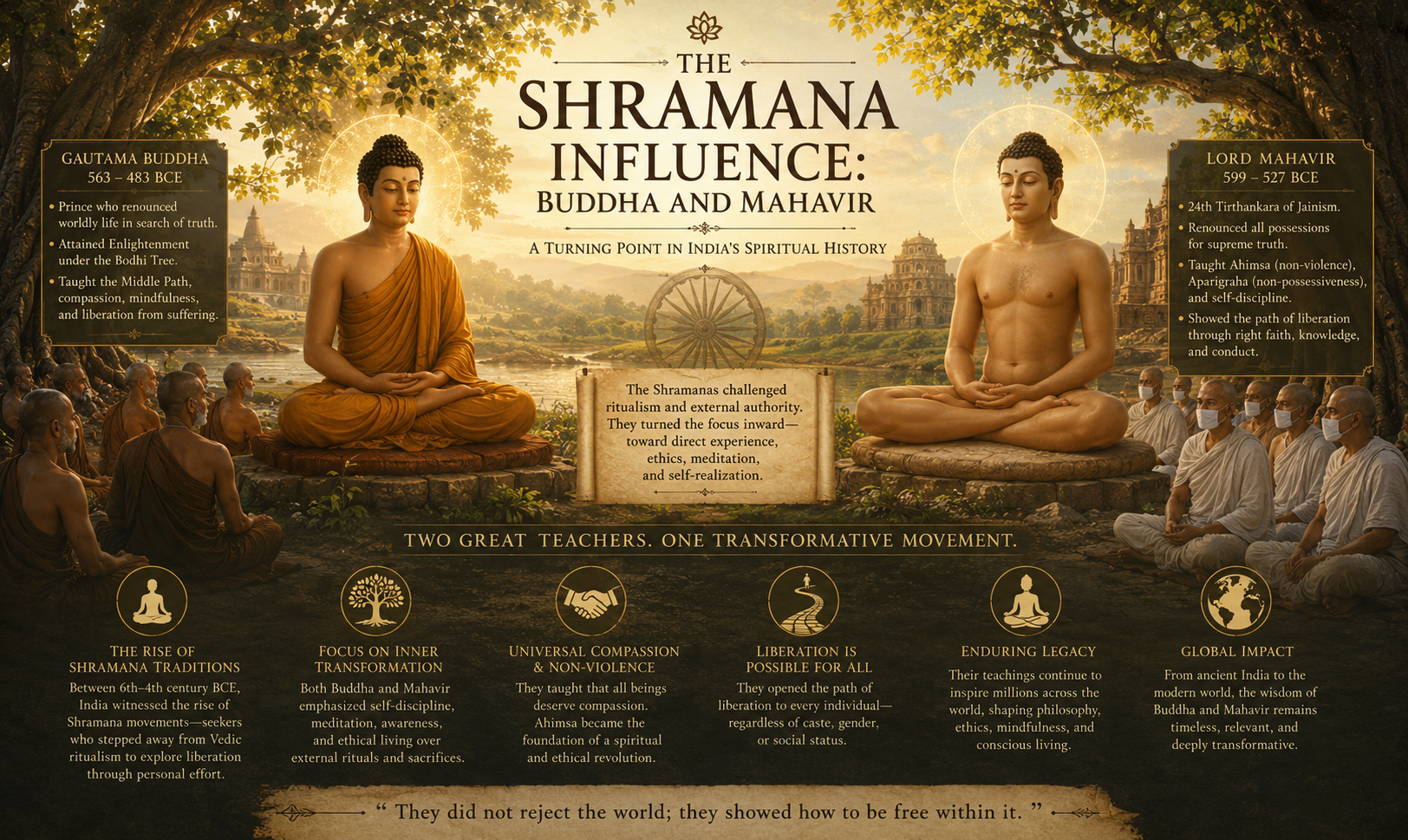
Ancient representation of a Shramana seeker in deep meditation
Around 2500 years ago, yoga received a massive psychological upgrade through the Shramana movements. Lord Mahavir and Gautama Buddha were scientists of the human condition. They didn't care for rituals; they cared for the root cause of suffering.
They taught us that the mind is like a wild elephant. You don't tame it with force; you tame it with awareness. Their emphasis on Vairagya (detachment) and Dhyana (meditation) became the pillars that later masters like Patanjali built upon.

Sage of Action:

The silence of the Buddha and the austerity of Mahavir provided a new depth to yoga. They shifted the focus of practice from outer rituals to inner awareness and personal liberation.

Section

Patanjali: The Scientist of the Mind

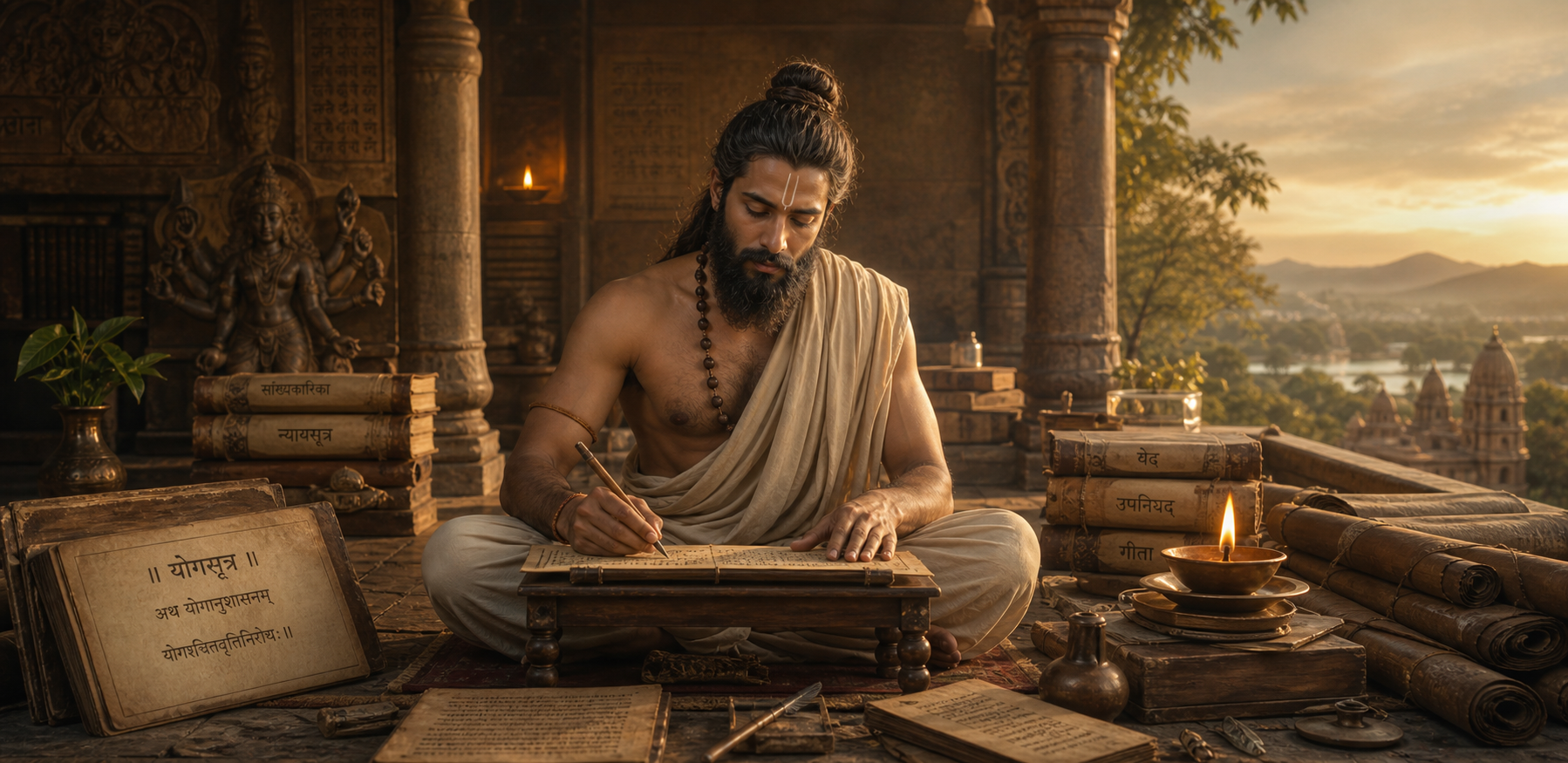
Maharishi Patanjali, the sage who organized the Eight Limbs of Yoga
If the Vedas were the poetry of yoga, Patanjali was its scientist. Traditionally placed around the 2nd century BCE to 4th century CE, he organized the chaos of existing practices into the Yoga Sutras. He defined yoga with surgical precision: Citta-Vritti-Nirodha, or the stilling of the mind's movements.
He gave us the Eight Limbs (Ashtanga). We must remember that Asana is only the third step. If we do asana without Yama (ethics) or Niyama (discipline), we are just doing gymnastics. Yoga requires the whole human, not just the skeleton.

Section

Hatha Logic: Mastery Through the Flesh

Around the 10th century, masters realized that the mind was too slippery to catch on its own. They turned to the body. Texts like the Amrtasiddhi, Amanaska, and the Hatha Yoga Pradipika developed a system using breath (Pranayama) and posture to force energy through the central channel (Sushumna).
They viewed the body as a temple and a bridge. Later medieval texts like the Gheranda Samhita and Shiva Samhita refined these techniques, turning the yogi into an alchemist who could transform his own energy into a steady state of meditation.

Section

The Modern Era: From Mysore to the World

In 1893, Swami Vivekananda introduced the West to Raja Yoga, focusing on the power of the mind. Later, the Mysore Palace became a hub for the physical revival. Manuscripts like the Sritattvanidhi and Krishnamacharya’s Yoga Makaranda (1934) bridged the gap between ancient philosophy and the dynamic practices we see today.

Sage of Action:

Today, we have 84,000 asanas but very little silence. We must return to the 'Adiyogi spirit.' Less focus on how the pose looks, more on how the mind feels. Yoga is not about self-improvement; it is about self-realization.

Section

The Architecture of Inwardness

The timeline of yoga is the record of humanity turning its gaze inward. Here is how that focus has sharpened over five millennia.
Prior to 2000 BCE

The Silent Roots

The era of the Indus-Saraswati valley. Seals found in ancient ruins are often interpreted as early evidence of seated meditative culture.

1500 - 1000 BCE

The Vedic Foundations

The four Vedas introduce imagery of yoking and alignment. Yoga is the harness for the mind.

1000 - 500 BCE

The Epics & The Gita

Mahabharata and Bhagavad Gita present yoga as a skill in action on the battlefield of life.

800 - 500 BCE

The Upanishadic Awakening

Discovery of the Witness and the unity of Atman and Brahman.

600 - 400 BCE

The Way of the Shramanas

Buddha and Mahavir emphasize ethics, detachment, and deep mental observation.

2nd c. BCE - 4th c. CE

The Classical Era

Patanjali organizes the Eight Limbs of Yoga in the Yoga Sutras.

1000 - 1700 CE

The Hatha Revolution

Rise of Hatha Yoga texts. The body as an energetic bridge to meditation.

1893 - Today

The Global Bridge

Yoga goes global via Swami Vivekananda and modern masters like Krishnamacharya.

Section

Previous Articles in this Series

This article is Part 3 of our series on the foundations of Yoga. If you missed the first two parts, you can read them here:

References used for the editorial direction